
- What happens to us when we die?
- Why do we die?
- Would it be comforting to know the truth about death?
1-3. What questions do people ask about death, and what answers do various religions offer?
THESE
are questions that people have thought about for thousands of years.
They are important questions. No matter who we are or where we live, the
answers concern each one of us.
2 In the preceding chapter, we discussed how the ransom sacrifice of Jesus Christ opened the way to everlasting life. We also learned that the Bible foretells a time when “death will be no more.” (Revelation 21:4) Meanwhile, we all die. “The living know that they will die,” said wise King Solomon. (Ecclesiastes 9:5) We try to live as long as possible. Still, we wonder what will happen to us when we die.
3 When
our loved ones die, we mourn. And we may ask: ‘What has happened to
them? Are they suffering? Are they watching over us? Can we help them?
Will we ever see them again?’ The world’s religions offer differing
answers to these questions. Some teach that if you live a good life, you
will go to heaven but if you live a bad life, you will burn in a place
of torment. Other religions teach that at death, people pass on to the
spirit realm to be with their
ancestors. Still other religions teach that the dead go to an
underworld to be judged and are then reincarnated, or reborn in another
body.
4. What basic idea do many religions share concerning death?
4 Such religious teachings all share one basic idea
WHAT REALLY HAPPENS AT DEATH?
5, 6. What does the Bible teach about the condition of the dead?
5 What
happens at death is no mystery to Jehovah, the Creator of the brain. He
knows the truth, and in his Word, the Bible, he explains the condition
of the dead. Its clear teaching is this: When a person dies, he ceases to exist. Death
is the opposite of life. The dead do not see or hear or think. Not even
one part of us survives the death of the body. We do not possess an immortal soul or spirit. *

Where did the flame go?
6 After Solomon observed that the living know that they will die, he wrote: “But the dead know nothing at all.” He
then enlarged on that basic truth by saying that the dead can neither
love nor hate and that “there is no work nor planning nor knowledge nor
wisdom in the Grave.” (Read Ecclesiastes 9:5, 6, 10.) Similarly, Psalm 146:4 says that when a man dies, “his thoughts perish.” We
are mortal and do not survive the death of our body. The life we enjoy
is like the flame of a candle. When the flame is put out, it does not go anywhere. It is simply gone.
WHAT JESUS SAID ABOUT DEATH
7. How did Jesus explain what death is like?
7 Jesus
Christ spoke about the condition of the dead. He did so with regard to
Lazarus, a man whom he knew well and who had died. Jesus told his
disciples: “Lazarus our friend has fallen asleep.” The disciples thought
that Jesus meant that Lazarus was resting in sleep, recovering from an
illness. They were wrong. Jesus explained: “Lazarus has died.” (Read John 11:11-14.) Notice
that Jesus compared death to sleep. Lazarus was neither in heaven nor
in a burning hell. He was not meeting angels or ancestors. Lazarus was
not being reborn as another human. He was at rest in death, as though in
a deep sleep without dreams. Other scriptures also compare death to
sleep. For example, when the disciple Stephen was stoned to death, the
Bible says that he “fell asleep.” (Acts 7:60) Similarly, the apostle Paul wrote about some in his day who had “fallen asleep in death.”

Jehovah made humans to live forever on earth
8. How do we know that it was not God’s purpose for people to die?
8 Was
it God’s original purpose for people to die? Not at all! Jehovah made
man to live forever on earth. As we learned earlier in this book, God
placed the first human couple in a delightful paradise. He blessed them with
perfect health. Jehovah wanted only good for them. Does any loving
parent want his children to suffer the pain of old age and death? Of
course not! Jehovah loved his children and wanted them to enjoy endless
happiness on earth. Concerning humans, the Bible says: “[Jehovah] has
even put eternity in their heart.” (Ecclesiastes 3:11) God created us with the desire to live forever. And he has opened the way for that desire to be fulfilled.
WHY HUMANS DIE
9. What restriction did Jehovah place upon Adam, and why was this command not difficult to obey?
9 Why,
then, do humans die? To find the answer, we must consider what happened
when there was only one man and one woman on earth. The Bible explains:
“Jehovah God made to grow out of the ground every tree that was
pleasing to look at and good for food.” (Genesis 2:9)
However, there was one restriction. Jehovah told Adam: “From every tree
of the garden you may eat to satisfaction. But as for the tree of the
knowledge of good and bad, you must not eat from it, for in the day you
eat from it you will certainly die.” (Genesis 2:16, 17)
This command was not difficult to obey. There were many other trees
from which Adam and Eve could eat. But they now received a special
opportunity to show their gratitude to the One who had given them
everything, including perfect life. Their obedience would also show that
they respected the authority of their heavenly Father and that they
wanted his loving direction.
10, 11. (a) How did the first human couple come to disobey God? (b) Why was the disobedience of Adam and Eve a serious matter?
10 Sadly,
the first human couple chose to disobey Jehovah. Speaking through a
serpent, Satan asked Eve: “Did God really say that you must not eat from
every tree of the garden?” Eve replied: “We may eat of the fruit of the
trees of the garden. But God has said about the fruit of the tree that
is in the middle of the garden: ‘You must not eat from it, no, you must
not touch it; otherwise you will die.’”
11 “You
certainly will not die,” said Satan. “God knows that in the very day
you eat from it, your eyes will be opened and you will be like God,
knowing good and bad.” (Genesis 3:4, 5) Satan wanted Eve to believe that she
would benefit by eating the forbidden fruit. According to him, she
could decide for herself what was right and what was wrong; she could do
what she wanted. Satan also charged that Jehovah had lied about the
consequences of eating the fruit. Eve believed Satan. So she picked some
of the fruit and ate it. She then gave some to her husband, and he too
ate some of it. They did not act in ignorance. They knew that they were
doing exactly what God had told them not to do. By eating the
fruit, they deliberately disobeyed a simple and reasonable command. They
showed contempt for their heavenly Father and his authority. Such
disrespect for their loving Creator was inexcusable!
12. What may help us to understand how Jehovah felt when Adam and Eve took a course of opposition to him?
12 To
illustrate: How would you feel if you raised and cared for a son or a
daughter who then disobeyed you in a way that showed that he or she had
no respect or love for you? That would cause you much heartache.
Imagine, then, how hurt Jehovah must have felt when both Adam and Eve
took a course of opposition to him.
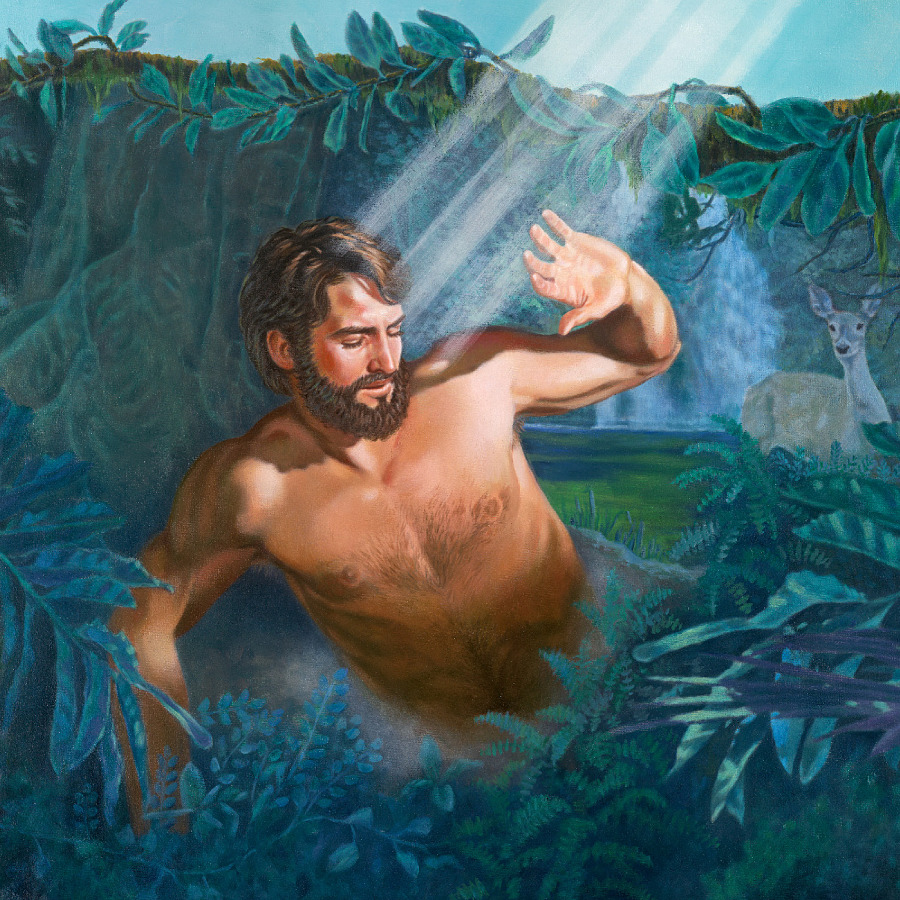
Adam came from the dust, and he returned to the dust
13. What did Jehovah say would happen to Adam at death, and what does this mean?
13 Jehovah
had no reason to sustain disobedient Adam and Eve forever. They died,
just as he had said they would. Adam and Eve ceased to exist. They did
not pass on to the spirit realm. We know this because of what Jehovah
said to Adam after confronting him with his disobedience. God said: “You
[will] return to the ground, for out of it you were taken. For dust you
are and to dust you will return.” (Genesis 3:19) God had made Adam from the dust of the ground. (Genesis 2:7)
Before that, Adam did not exist. Therefore, when Jehovah said that Adam
would return to the dust, He meant that Adam would return to a state of
nonexistence. Adam would be as lifeless as the dust from which he was
made.
14. Why do we die?
14 Adam
and Eve could have been alive today, but they died because they chose
to disobey God and thus sinned. The reason we die is that Adam’s sinful
condition as well as death was passed on to all of his descendants. (Read Romans 5:12.) That
sin is like a terrible inherited disease from which no one can escape.
Its consequence, death, is a curse. Death is an enemy, not a friend. (1 Corinthians 15:26) How grateful we can be that Jehovah provided the ransom to rescue us from this dreadful enemy!
KNOWING THE TRUTH ABOUT DEATH IS BENEFICIAL
15. Why is it comforting to know the truth about death?
15 What
the Bible teaches about the condition of the dead is comforting. As we
have seen, the dead do not suffer pain or heartache. There is no reason
to be afraid of them, for they cannot harm us. They do not need our
help, and they cannot help us. We cannot speak with them, and they
cannot speak with us. Many religious leaders falsely claim that they can
help those who have died, and people who believe such leaders give them
money. But knowing the truth protects us from being deceived by those
who teach such lies.
16. Who has influenced the teachings of many religions, and in what way?
16 Does
your religion agree with what the Bible teaches about the dead? Most do
not. Why? Because their teachings have been influenced by Satan. He
uses false religion to get people to believe that after their body dies,
they will continue to live in the spirit realm. This is a lie that
Satan combines with other lies to turn people away from Jehovah God. How
so?
17. Why does the teaching of eternal torment dishonor Jehovah?
17 As
noted earlier, some religions teach that if a person lives a bad life,
after death he will go to a place of fiery torment to suffer forever.
This teaching dishonors God. Jehovah is a God of love and would never
make people suffer in this way. (Read 1 John 4:8.) How
would you feel about a man who punished a disobedient child by holding
his hands in a fire? Would you respect such a man? In fact, would you
even want to get to know him? Definitely not! You would likely think
that he was very cruel. Yet, Satan wants us to believe that Jehovah
tortures people in fire forever
18. Worship of the dead is based on what religious lie?
18 Satan
also uses some religions to teach that after death people become
spirits who must be respected and honored by the living. According to
this teaching, the spirits of the dead can become powerful friends or
terrible enemies. Many people believe this lie. They fear the dead and
give them honor and worship. In contrast, the Bible teaches that the
dead are sleeping and that we should worship only the true God, Jehovah,
our Creator and Provider.
19. Knowing the truth about death helps us to understand what other Bible teaching?
19 Knowing
the truth about the dead protects you from being misled by religious
lies. It also helps you to understand other Bible teachings. For
example, when you realize that people do not pass on to the spirit realm
at death, the promise of everlasting life on a paradise earth takes on
real meaning for you.
20. What question will we consider in the next chapter?
20 Long ago, the righteous man Job raised this question: “If a man dies, can he live again?” (Job 14:14) Can a lifeless person who is sleeping in death be brought back to life? What the Bible teaches about this is deeply comforting, as the next chapter will show.


0 comments: