Friday, 29 July 2016

What does the Bible say about self-discipline?
"What does the Bible say about self-discipline?"

Answer: Self-discipline is essentially the same as self-control, one of the nine fruits of the Spirit listed by Paul in Galatians 5:22-23. The KJV translation uses the word temperance in place of “self-control” which, like self-discipline, generally refers to our ability to control or restrain ourselves from all kinds of feelings, impulses, and desires, which includes the desire for physical and material comfort. Now, even though self-control is the last of the spiritual fruits mentioned by Paul, and even though it is a term not used extensively in the Bible, self-control is clearly an indispensable attribute of the Christian life, especially as our unredeemed flesh sometimes causes us to succumb to the persistent tug of our sinful desires.The apostle Paul calls us to “purify ourselves from everything that contaminates body and spirit, perfecting holiness out of reverence for God” (2 Corinthians 7:1). And in his letter to the Romans, he exhorts us to “offer your bodies as living sacrifices, holy and pleasing to God,” and not to be conformed to the pattern of this world (Romans 12:1-2). Yet most Christians would agree that subordinating the constant pull of these worldly desires in order to please our Lord is not always an easy thing to do. Paul discusses his own inner conflict and struggle with sin in his letter to the Romans, “What I want to do I do not do…the evil I do not want to do – this I keep on doing…it is sin living in me that does it” (Romans 7:15-20).It is clear that our seemingly insatiable human appetites and needs can easily lead to sinful excesses if not controlled. Especially in affluent societies, the lack of self-discipline is rampant, as evidenced by the number of obese people and the extensive use of stimulants, depressants and over-the-counter medications. Further, the enticements of the material world have caused many to yearn for and acquire material goods far beyond their needs and their ability to pay for them. Indeed, the nations of the world have fallen into the same trap, borrowing trillions of dollars to finance bloated budgets that result from the inability to exercise self-discipline. For Christians, without self-discipline, our appetites for comforts and pleasures can easily become our master and lead us into sin or otherwise hinder us in our spiritual walk. If the spiritual does not govern the physical, we can become easy targets for Satan due to our lack of self-control (1 Corinthians 7:5).Paul discusses self-discipline in his letter to the Corinthian church. As the Greeks had the Olympic games and the Isthmian games, they were very familiar with the rigors of athletic training, especially if one wanted to win the “prize” or the “crown.” Paul analogizes living a disciplined Christian life to an athlete in training: “Everyone who competes in the games goes into strict training” (1 Corinthians 9:25). When Paul says “I beat my body and make it my slave,” he is saying that his body is under the dominion and control of his mind, not the other way around. Paul is showing us how self-control is needed to win the race that is before us and to live the life that is “holy and pleasing to God.” For Paul, the “race” was winning souls for Christ, a goal which he states four times in verses 19-22.It is important to understand that self-control is a work of the Holy Spirit, not a work of the individual. After all, Galatians 5:22-23 lists the fruit of the Spirit, not the fruit of the Christian. As we are merely the branches upon which the Vine (Christ) hangs the fruit He produces (John 15:1-8), it is the indwelling presence of the Holy Spirit that gives Christians the power and ability to exercise self-control so that we will not be mastered by the “cravings of sinful man.” As Paul said, “God did not give us a Spirit of timidity, but a Spirit of power, of love and of self-discipline” (2 Timothy 1:7). Indeed, Christians are controlled not by the sinful nature, but by the Holy Spirit (Romans 8:9), who helps us in our weakness (v.26), which makes us able to say “no” to sin.The wise King Solomon wrote many proverbs for the purpose of helping us to live a “disciplined” and prudent life (Proverbs 1:3). Certainly, we will be more victorious in our Christian walk when we exercise our Spirit-given self-control, that which helps us respond in obedience to the commands of Scripture and allows us to grow in our spiritual life.
"What does the Bible say about self-worth?"

Answer:
The Bible actually has many passages that tell us what God has to say about our worth and our value in His eyes. Genesis 1:26-27 says we are made in His image, the very image of God. Psalm 139:13-16 says we are fearfully and wonderfully made, and all the days of our lives were written in God’s book before we were ever born, confirming God’s prior knowledge and plan for our lives. Ephesians 1:4 says God chose His children before the foundations of the earth were ever formed, and in Ephesians 1:13-14 we’re told we are God’s own possession, chosen for the praise of His glory, and that we have an inheritance in heaven with Him as His children.

But notice the wording in each of the above phrases: “are made,” “are fearfully and wonderfully made,” “were written,” “God chose His children,” “we are God’s own possession,” and “we have an inheritance.” These phrases all have one thing in common: they are things done to us or for us by God. These are not things we have done for ourselves, nor have we earned or deserved them. We are, in fact, merely the recipients of “all spiritual blessings in heavenly places in Christ” (Ephesians 1:3). Therefore, we can conclude that our worth is not really of the “self” at all; rather, it is worth given to us by God. We are of inestimable value to Him because of the price He paid to make us worthy—the death of His Son on the cross.

The Bible tells us that “while we were yet sinners, Christ died for us” (Romans 5:8). In fact, we “were dead in trespasses and sins” (Ephesians 2:1). What worth is there in dead things? None. God imputed to us His own righteousness (2 Corinthians 5:21) not because we were worthy of it, but because we were unworthy, unlovable, and unable to make ourselves worthy in any way. But—and here’s the miracle—He actually loved us in spite of our condition (John 3:16), and because He did, we now have infinite worth.

John 1:12 tells us that to those who received Christ and believed in His name, God gave the right to become His children. First John 1:9 tells us that if we confess our sins, He is faithful to forgive our sins and cleanse us from all unrighteousness. If we focus on how much God loves us and the price He paid to redeem us, we’ll come to see ourselves as God sees us, and that will help us understand just how much we’re really worth as children of the most high God.

Our self-worth is too often based on what other people tell us about ourselves. The one, true authority on our self-worth is Jesus Christ, and since He gave His own life up for us by dying on a cross, that should tell us just how valuable we really are.
"How can I know if I am one of the elect?"

Answer:
While there are numerous ideas of precisely what election means in regards to salvation, the fact that believers are elect is indisputable (Romans 8:29-30; Ephesians 1:4-5, 11; 1 Thessalonians 1:4). Simply put, the doctrine of election is that God chooses/determines/elects/predestines who will be saved. It is not within the scope of this article to determine how election works. Rather, the question is “How can I know if I am one of the elect?” The answer is exceedingly simple: believe!

The Bible nowhere instructs us to be concerned regarding our status of elect vs. non-elect. Rather, God calls us to believe, to receive Jesus Christ as Savior, by grace through faith (John 3:16; Ephesians 2:8-9). If a person truly trusts in Jesus alone for salvation, that person is one of the elect. Whether belief secures election, or election causes belief – that is another debate. But what is sure that belief is evidence of election. No one can receive Jesus as Savior unless God draws him or her (John 6:44). God calls/draws those whom He has predestined/elected (Romans 8:29-30). Saving faith is not possible without divine election. Therefore, saving faith is evidence of election.

The idea of a person wanting to be saved but being unable to, due to not being one of the elect, is absolutely foreign to the Bible. No one seeks after God’s plan of salvation on his own accord (Romans 3:10-18). Those without Christ are blind to their need for salvation (2 Corinthians 4:4). This only changes when God begins drawing a person to Himself. It is God who opens eyes and enlightens minds to the need for Jesus Christ as Savior. A person cannot repent (change the mind about sin and the need for salvation) unless God grants repentance (Acts 11:18). Therefore, if you understand God’s plan of salvation, recognize your need for it, and feel compelled to receive Jesus Christ as your Savior, then believe, and you are saved.

If you have received Jesus Christ as your Savior, trusting Him alone for salvation, believing that His sacrifice is the full payment for your sins – congratulations, you are one of the elect.
What did Jesus mean when He said 'I AM'?
"What did Jesus mean when He said 'I AM'?"

Answer:
Jesus, in response to the Pharisees’ question “Who do you think you are?” said, “‘Your father Abraham rejoiced at the thought of seeing my day; he saw it and was glad.’ ‘You are not yet fifty years old,’ the Jews said to him, ‘and you have seen Abraham!’ ‘I tell you the truth,’ Jesus answered, ‘before Abraham was born, I am!’ At this, they picked up stones to stone him, but Jesus hid himself, slipping away from the temple grounds” (John 8:56–59). The violent response of the Jews to Jesus’ “I AM” statement indicates they clearly understood what He was declaring—that He was the eternal God incarnate. Jesus was equating Himself with the "I AM" title God gave Himself in Exodus 3:14.

If Jesus had merely wanted to say He existed before Abraham’s time, He would have said, “Before Abraham, I was.” The Greek words translated “was,” in the case of Abraham, and “am,” in the case of Jesus, are quite different. The words chosen by the Spirit make it clear that Abraham was “brought into being,” but Jesus existed eternally (see John 1:1). There is no doubt that the Jews understood what He was saying because they took up stones to kill Him for making Himself equal with God (John 5:18). Such a statement, if not true, was blasphemy and the punishment prescribed by the Mosaic Law was death (Leviticus 24:11–14). But Jesus committed no blasphemy; He was and is God, the second Person of the Godhead, equal to the Father in every way.

Jesus used the same phrase “I AM” in seven declarations about Himself. In all seven, He combines I AM with tremendous metaphors which express His saving relationship toward the world. All appear in the book of John. They are I AM the Bread of Life (John 6:35, 41, 48, 51); I AM the Light of the World (John 8:12); I AM the Door of the Sheep (John 10:7, 9); I AM the Good Shepherd (John 10:11,14); I AM the Resurrection and the Life (John 11:25); I AM the Way, the Truth and the Life (John 14:6); and I AM the True Vine (John 15:1, 5).
Who am I in Christ?
 "Who am I in Christ?"

Answer:
According to 2 Corinthians 5:17, “If anyone is in Christ, he is a new creation; the old has gone, the new has come!” There are two Greek words which are translated “new” in the Bible. The first, neos, refers to something that has just been made, but there are already many others in existence just like it. The word translated “new” in this verse is the word kainos, which means “something just made which is unlike anything else in existence.” In Christ, we are made an entirely new creation, just as God created the heavens and the earth originally—He made them out of nothing, and so He does with us. He does not merely clean up our old selves; He makes an entirely new self. When we are in Christ, we are “partakers of the divine nature” (2 Peter 1:4 KJV). God Himself, in the person of His Holy Spirit, takes up residence in our hearts. We are in Christ and He is in us.

In Christ, we are regenerated, renewed, and born again, and this new creation is spiritually minded, whereas the old nature is carnally minded. The new nature fellowships with God, obeys His will, and is devoted to His service. These are actions the old nature is incapable of doing or even desiring to do. The old nature is dead to the things of the spirit and cannot revive itself. It is “dead in trespasses and sins” (Ephesians 2:1) and can only be made alive by a supernatural awakening, which happens when we come to Christ and are indwelt by Him. Christ gives us a completely new and holy nature and an incorruptible life. Our old life, previously dead to God because of sin, is buried, and we are raised “to walk in newness of life” with Him (Romans 6:4).

If we belong to Christ, we are united to Him and no longer slaves to sin (Romans 6:5-6); we are made alive with Him (Ephesians 2:5); we are conformed to His image (Romans 8:29); we are free from condemnation and walking not according to the flesh, but according to the Spirit (Romans 8:1); and we are part of the body of Christ with other believers (Romans 12:5). The believer now possesses a new heart (Ezekiel 11:19) and has been blessed “with every spiritual blessing in the heavenly places in Christ Jesus” (Ephesians 1:3).

We might wonder why we so often do not live in the manner described, even though we have given our lives to Christ and are sure of our salvation. This is because our new natures are residing in our old fleshly bodies, and these two are at war with one another. The old nature is dead, but the new nature still has to battle the old “tent” in which it dwells. Evil and sin are still present, but the believer now sees them in a new perspective and they no longer control him as they once did. In Christ, we can now choose to resist sin, whereas the old nature could not. Now we have the choice to either feed the new nature through the Word, prayer, and obedience, or to feed the flesh by neglecting those things.

When we are in Christ, “we are more than conquerors through Him that loved us” (Romans 8:37) and can rejoice in our Savior, who makes all things possible (Philippians 4:13). In Christ we are loved, forgiven, and secure. In Christ we are adopted, justified, redeemed, reconciled, and chosen. In Christ we are victorious, filled with joy and peace, and granted true meaning in life. What a wonderful Savior is Christ!
What does the Bible say about self-worth?
"What does the Bible say about self-worth?"

Answer:
The Bible actually has many passages that tell us what God has to say about our worth and our value in His eyes. Genesis 1:26-27 says we are made in His image, the very image of God. Psalm 139:13-16 says we are fearfully and wonderfully made, and all the days of our lives were written in God’s book before we were ever born, confirming God’s prior knowledge and plan for our lives. Ephesians 1:4 says God chose His children before the foundations of the earth were ever formed, and in Ephesians 1:13-14 we’re told we are God’s own possession, chosen for the praise of His glory, and that we have an inheritance in heaven with Him as His children.

But notice the wording in each of the above phrases: “are made,” “are fearfully and wonderfully made,” “were written,” “God chose His children,” “we are God’s own possession,” and “we have an inheritance.” These phrases all have one thing in common: they are things done to us or for us by God. These are not things we have done for ourselves, nor have we earned or deserved them. We are, in fact, merely the recipients of “all spiritual blessings in heavenly places in Christ” (Ephesians 1:3). Therefore, we can conclude that our worth is not really of the “self” at all; rather, it is worth given to us by God. We are of inestimable value to Him because of the price He paid to make us worthy—the death of His Son on the cross.

The Bible tells us that “while we were yet sinners, Christ died for us” (Romans 5:8). In fact, we “were dead in trespasses and sins” (Ephesians 2:1). What worth is there in dead things? None. God imputed to us His own righteousness (2 Corinthians 5:21) not because we were worthy of it, but because we were unworthy, unlovable, and unable to make ourselves worthy in any way. But—and here’s the miracle—He actually loved us in spite of our condition (John 3:16), and because He did, we now have infinite worth.

John 1:12 tells us that to those who received Christ and believed in His name, God gave the right to become His children. First John 1:9 tells us that if we confess our sins, He is faithful to forgive our sins and cleanse us from all unrighteousness. If we focus on how much God loves us and the price He paid to redeem us, we’ll come to see ourselves as God sees us, and that will help us understand just how much we’re really worth as children of the most high God.

Our self-worth is too often based on what other people tell us about ourselves. The one, true authority on our self-worth is Jesus Christ, and since He gave His own life up for us by dying on a cross, that should tell us just how valuable we really are.

Thursday, 21 July 2016

Why Do We Plant Churches?

Why Do We Plant Churches?

Church planting is joining God in His unstoppable mission to mature & multiply disciples from every nation by the power of the gospel.
boettcherThe gospel is the good news that the Father sent Jesus in the power of the Holy Spirit to renew a fallen world for His glory. Through His life, death, and resurrection, Jesus secured the redemption of all God’s people, from all time, to dwell with Him forever. Jesus then commissioned His church to join Him in gathering His people by making disciples (Matthew 28:18–20).
Once He ascended, Jesus sent the promised Holy Spirit to empower His church to be disciple-making disciples in thriving local communities as church-planting churches until He returns (Acts 1:8).
One day Jesus will return and make all things new. Where He is, His glorious church will be enjoying pleasures forever in His presence (Psalm 16:11).
IMG_8845We plant churches because the same God who appointed this glorious end has also appointed the means to get there. God has entrusted His church with the gospel, and He works through the work of His disciple-making disciples to plant church-planting churches until Jesus returns. God is doing something big and breathtaking, and we get to be a part of it. This is why we plant and build churches with the gospel for the glory of God.
Church Planting

Church Planting

The Alliance began with one church plant—the Gospel Tabernacle in New York City. It grew into a healthy congregation reaching the surrounding community and training and sending workers and leaders to reach the world.
From this one church, today—129 years later—more than 25,000 fellowships and nearly 6 million believers have emerged. Clearly, the Great Commission is fulfilled when Christian leaders GO plant churches or equip and SEND others to do so.

GO:

Is God Calling You to Plant a Church?

If you believe God may be calling you to plant, consider the following:
  • Take the free church planter assessment to gain a better understanding of your gifts and suitability for church planting. (We may ask you to take a $99 version later.)
  • After you complete the initial online screening, contact the Alliance District or Regional leader in your area about possibly planting a church, or e-mail Kim Vincent at the National Office at vincentk@cmalliance.org or call (719) 265-2047.

SEND:

Is God Calling your Church to Become a Greenhouse Church?

A greenhouse provides a healthy environment for plants to grow. Greenhouse Churches provide a healthy atmosphere for Christian leaders to develop as church planters.

What is a Greenhouse Church?

We have two excellent examples of Greenhouses: One is the previously mentioned Gospel Tabernacle. An outstanding biblical example is the church at Antioch in the Book of Acts. Its members were willing to help their fellow believers (Acts 11:27–30) and send workers to plant churches (Acts 13:1–3).
  • DO SOMETHING! In Acts 11:27–30, the Antioch church provided assistance to members of other churches. We can do so as well. Check out 10 WAYS TO HELP A CHURCH PLANT and pick one or two on which to focus. Or visit our regional church–planting page for detailed information and links.
  • SEND SOMEONE! In Acts 13:1–3, the Antioch congregation sent Paul and Barnabas, two of history’s greatest church planters. This young church didn’t seek to keep these leaders for themselves. As this example demonstrates, the real issue for a Greenhouse is willingness, not resources, size, age, or culture. Are there people God brought to your church whom He is asking you to train and send out?

10 WAYS TO HELP A CHURCH PLANT

  • 1) Pray intentionally for church planters and their teams.

    Prayer is the primary work of God’s people. You and your church can partner in this vital work by encouraging a new plant through prayer. Would your congregation consider “adopting” a local church planter and pray regularly and intentionally for that leader’s church?
  • 2) Invite planters to share their vision with your board and church.

    Who are the planters in your vicinity? Consider this option as a great way to encourage church planters and cast vision among your people.
  • 3) Pick a planting couple and support them financially.

    Salaries are rarely stable in church planting. Sacrificial, generous giving from churches and individuals, over and above their regular offerings, is a welcome demonstration of Christian unity.
  • 4) Bless a church plant with a one-time gift.

    A new church always has equipment needs. Contact a local church planter and ask how your congregation can help.
  • 5) Send a planting couple to dinner or on an overnight retreat.

    Planting is difficult, lonely work. A gift like this can really encourage a planting couple—and result in a lasting friendship with them.
  • 6) Encourage your congregation to hold a “baby shower” for a plant.

    Give the plant startup gifts, such as office supplies, sound and video equipment, etc. Ask planters to put together a “registry” of items they need if this is something your church would like to do.
  • 7) Plan to put church planting as a line item into your next budget.

    Where your treasure is, your heart will be. One of the best ways to encourage church planting is to promote it in your church, share inspiring stories from planters, and start budgeting for it.
  • 8) Send team members from your church to participate in a church plant.

    God owns everything, and we are managers. Please consider sending leaders God has called from your church to plant a new congregation.
  • 9) Use your church facility to host church–planting teams, services, or training.

    Invite a church plant to your facility for team meetings, events, or services if space is available. Consider hosting a church-planting training event at your church.
  • 10) Develop and deploy a planter and team from your church to start a new work.

    Take a faith–filled risk and plant a church! This process begins when you identify and train leaders with the purpose of sending them out to start a new congregation. Think of the Antioch church sending Paul and Barnabas in Acts 13. And don’t wait until you feel “ready”–you’ll never feel quite ready for such a significant undertaking.

Wednesday, 20 July 2016

What Is Discipleship?
  • What Is Discipleship?

    Introduction

    While every disciple is a believer, not every believer is necessarily a disciple.
    Many may think that the term disciple refers only to the early followers of Christ. We know that they were a praying, worshipping, loving, giving, and evangelizing group of men and women who refused to keep the truth of the gospel to themselves. Yet, God still desires disciples today—ordinary people like you and me whom God can use to do extraordinary things.
    The Christian experience of the believers in the first-century church may seem radical to many in the church today, but to those early believers, it was normal Christianity. And these men and women—empowered and motivated by the Holy Spirit—turned their world upside down for the sake of Christ. In short, they were true disciples of Jesus Christ.
  • Are We True Disciples?

    If you are a true disciple, your Christian walk will be challenging and exciting, and you will have a sense of purpose and direction. But if your Christian experience can be described as dull, unfulfilling, and even boring at times, you need to seriously examine the statements Jesus made concerning what it means to be a disciple. After all, how can we expect to fulfill the Great Commission (Mark 16:15; Matthew 28:19) to go into all the world and make disciples if we don't even really know what one is? It literally takes one to make one.
    A disciple is defined as a learner, a pupil, one who comes to be taught.
    The relationship between the disciple and his teacher is not merely that of a student listening to a lecturer, or a passively interested listener. A disciple listens with attention and intention. He drinks in every word of his teacher, marking every inflection of voice with an intense desire to apply what has been learned.
  • The Requirements of Discipleship

    In Luke 14:25–35, Jesus laid out the tests and requirements of discipleship. Jesus saw a large crowd gathering. He knew that these people believed and accepted His message in principle. Prior to this point, Jesus had shown how the message of the gospel was for everyone. He had exposed the Pharisees as the religious hypocrites that they were. As a result, He had become enormously popular. Now He wanted to weed out those who were following Him for the wrong reasons.
    Some wanted to be dazzled by Jesus' miracles, while others came looking for a free meal. A few even hoped that He would overthrow Rome and establish God's kingdom. So Jesus turned to the multitude and preached a sermon that deliberately thinned out the ranks.
    Jesus seeks quality over quantity
    Jesus makes it clear that when it comes to personal discipleship, He is more interested in quality than quantity. The words He spoke that day are perhaps the most solemn and searching words that ever fell from His lips.
    Why would Jesus say such things to all those people who followed Him? It seems that He is intentionally trying to get rid of them. In a sense, He is trying to get rid of at least some of them.
    A similar account is found in Judges 7:1–22. There God wanted to give His servant Gideon a victory in battle against the Midianites. But the Lord wanted the glory for the victory. So, through a series of tests, God whittled down Gideon's original army of 32,000 to 300. God knew that He could do more with 300 alert, committed men than He could with 32,000 half-hearted ones.
    Three times in the course of this message in Luke 14, Jesus used the phrase, "cannot be my disciple." In other words, Jesus was laying out some absolute requirements for discipleship.
  • Requirement #1: Love God More Than Anyone Else

    Jesus begins with some very strong words: "If anyone comes to Me and does not hate his father and mother, wife and children, brothers and sisters, yes, and his own life also, he cannot be My disciple" (Luke 14:26).
    Jesus was not advocating that in order to be disciples, we must actually hate family, friends, and ourselves. In this verse, Jesus was using sharp contrasts to make a point. Here He uses the word hate as the opposite of love. He did not choose something easily hated, like sin. Instead, He chose the most noble love we could have in this world—the love of family. He uses this analogy to show that our love for God must take pre-eminence over all others.
    Your love for God should be so strong that your love for others is like hatred by comparison.
    We see how personal relationships can conflict with the call of discipleship in Luke 9. There, Jesus asked someone to follow Him, but the man responds with this excuse: "Lord, let me first go and bury my father." (Luke 9:59)
    Right there, a conflict arises. If He is truly Lord, then He is first, not us. This man was essentially saying, "Lord, let me wait until my parents grow old and die. I don't want to create any conflict. I'll follow You at a more convenient time."
    Jesus answered: "Let the dead bury their own dead, but you go and preach the kingdom of God." (Luke 9:60)
    In this life, you either will have harmony with people and friction with God, or harmony with God and friction with people. You cannot have it both ways.
    "Do not think that I came to bring peace on earth. I did not come to bring peace but a sword. For I have come to set a man against his father, a daughter against her mother, and a daughter-in-law against her mother-in-law" (Matthew 10:34-35).
    You must decide which way it will go. If you choose harmony with God, the conflict you experience with others may ultimately lead to the awareness of their own need to find harmony with God.
  • A Test of Devotion

    Jesus wants to test our hearts. He wants to be sure that we love Him more than anyone or anything else.
    Abraham of the Old Testament seemed to struggle with this. God gave him a son, Isaac, in his old age. The boy was precious to Abraham's life, the joy of his heart. This young man was a physical representation of everything sacred to Abraham's heart: the covenants God had made and the physical link to the coming Messiah.
    As Abraham watched Isaac grow from a little baby to a strong, young man, perhaps this child began to fill the spot that Abraham had previously reserved for his friend, God. Perhaps, at this point in his life, had he been asked whom he loved more—Isaac or God—it would have been difficult to answer.
    A.W. Tozer writes, "It was then that God stepped in to save both father and son from the consequences of an uncleansed love." So God said, "Take now your son, your only son Isaac, whom you love, and go to the land of Moriah, and offer him there as a burnt offering on one of the mountains of which I shall tell you" (Genesis 22:2).
    • Abraham passed the test.
      When Abraham so wonderfully passed this test, God blessed him and spared his son (Genesis 22:3–18). In essence, God told him, "It's all right, Abraham. I never intended that you actually kill Isaac. I only wanted to remove him from the temple of your heart that I might remain unchallenged there."
      After this test in Abraham's life, there was nothing in his life that was not committed to the Lord. He still had great wealth, flocks, and possessions. He still had his son Isaac. He had everything, but he possessed nothing! His grip was very light on these things, and tighter on the eternal. Again, to quote Tozer: "Everything is safe which we commit to Him, and nothing is really safe which is not so committed."
      God is still looking for men and women who will shake their world, men and women who will be His disciples. I urge you to make that step. If you do, our world will never be the same again. English evangelist John Wesley once said, "Give me a hundred men who love God with all of their hearts and fear nothing but sin, and I will move the world."
    • A personal thought
      Will you dedicate your Isaac to the Lord today? It could be a family member or friend you love more than God. It may be a relationship you are in at the moment. It may be some sort of pursuit you are afraid to give up.
      Will you step out from the fickle multitudes and fair-weather followers today and be a true disciple of Jesus, loving Him more than anyone or anything else?
  • The Cost of Discipleship

    If ever there comes a time when the call of the highest earthly love and the cross of Christ are in conflict, the call of Christ must prevail. According to Jesus, a disciple is someone who loves God more than anyone else—even family and friends.
  • Requirement #2: Deny Yourself and Take up the Cross

    "And whoever does not bear his cross and come after Me cannot be My disciple." (Luke 14:27).
    "If anyone desires to come after Me, let him deny himself, and take up his cross daily, and follow Me." (Luke 9:23)
    The greatest barrier to discovering all that God has for us is our preoccupation with self. We have become a self-obsessed society—Jesus' mandate goes against the grain of popular culture. In fact, many in the church today have been advocating that the answer to most of the problems in our society is to build up our self-esteem and feelings of self-worth.
    • Our self-love versus our sinful nature
      The Bible plainly teaches that we have an inherently sinful nature (Proverbs 20:9; Romans 3:23; 5:12–13; 1 John 1:8). The apostle Paul seemed to have pretty low self-esteem when he cried, "O wretched man that I am!" (Romans 7:24).
      The Bible makes it clear that it is not a lack of love for oneself that causes problems in society; it is the obsession with self. In fact, this love of self will be one of the earmarks of the last days, leading to a host of other problems (see 2 Timothy 3:1–5).
      Scripture acknowledges the fact that we already love ourselves. Ephesians 5:29 says, "After all, no one ever hated his own body, but he feeds and cares for it" No, Jesus did not say that we need to love ourselves (we already do that). He told us to deny ourselves. To better understand the significance of this, we must first understand what that means.
    • The word denial means to repudiate; to disdain; to disown; to forfeit; to totally disregard.
      C.S. Lewis once wrote, "The real test of being in the presence of God is that you either forget about yourself altogether or you see yourself as a small, dirty object. It is better to forget about yourself altogether."
      What is the positive outcome of denying yourself? Jesus goes on to say,
      "For whoever desires to save his life will lose it, but whoever loses his life for My sake will save it" (Luke 9:24). The word for "life" in the original Greek was psuche, meaning "soul life"—literally your will, ambition, goals and desires. When you give that up to allow yourself to be conformed into the image of Jesus, you will discover His plan and purpose for you.
    • Bearing your cross means dying to oneself.
      Why did Jesus use this particular illustration? He used a radical symbol to get people's attention. He was not simply speaking of an individual's personal problem or obstacle. In that day and age, a person who was bearing a cross was walking to his death. Bearing your cross means dying to self—laying aside your personal goals, desires and ambitions so that God can reveal His desires, ambitions and goals for your life. In essence, it is living life as it was meant to be lived: in the will of God.
      Samuel Rutherford said, "The cross of Christ is the sweetest burden that I ever bore. It is a burden to me such as wings are to a bird or sails are to a ship to carry me forward to my harbor."
      "In every Christian's heart there is a cross and a throne, and the Christian is on the throne till he puts himself on the cross; if he refuses the cross, he remains on the throne. Perhaps this is at the bottom of the backsliding and worldliness among gospel believers today. We want to be saved, but we insist that Christ do all the dying. No cross for us, no dethronement, no dying. We remain king within the little kingdom of Man's soul and wear our tinsel crown with all the pride of a Caesar; but we doom ourselves to shadows and weakness and spiritual sterility" (A.W. Tozer).
  • Requirement #3: Forsake All That You Have

    "So likewise, whoever of you does not forsake all that he has cannot be My disciple" (Luke 14:33).
    To forsake means to surrender your claim to; to say goodbye to.
    Until I recognize that everything I have belongs to Jesus Christ, I am not His disciple. Consider Jesus' encounter with the rich young ruler who asked Jesus, "What must I do to inherit eternal life?" (Mark 10:17).
    "Jesus answered, 'You know the commandments: Do not murder. Do not commit adultery. Do not steal. Do not testify falsely. Do not cheat. Honor your father and mother.' 'Teacher,' the man replied, 'I've obeyed all these commandments since I was a child.'"
    "Jesus felt genuine love for this man as He looked at him. 'You lack only one thing,' He told him. 'Go and sell all you have and give money to the poor, and you will have treasure in heaven. Then come, follow me.' At this, the man's face fell, and he went sadly away because he had many possessions" (Mark 10:19–22 NLT).
    Jesus was not implying that to follow Him, we need to take a vow of poverty. He asked this man to "sell all he had" because He could see that possessions were the god of this man's life. If something else had been on the "throne of his life," Jesus would have asked him for that.
  • Requirement #4: Count the Cost

    "For which of you, intending to build a tower, does not sit down first and count the cost, whether he has enough to finish it" (Luke 14:28).
    Jesus underlines the importance of counting the cost of discipleship. Many people make impulse purchases without even considering the cost, or they rush into marriage or a career. Sadly, some do the same in their commitment to follow Christ.
    This point is illustrated in Luke 9:57–58: "Now it happened as they journeyed on the road, that someone said to Him, 'Lord, I will follow You wherever You go.' And Jesus said to him, 'Foxes have holes and birds of the air have nests, but the Son of Man has nowhere to lay His head.'"
    The man in this story did not even wait to be called. He hastily volunteered. He seemed to have a good heart, but he was impulsive. No doubt he had been watching Jesus with great admiration, and now wanted to walk with Him. But he had not counted the cost!
    This man did not know what lay in his future, but Jesus did. By the nature of Jesus' statement to him, it would appear that this man, in contrast to the one who wanted to avoid friction with family and friends, was too concerned with material things in general. In essence, Jesus was saying to this man (and to all who would be His disciples), "Whatever would dull your desire to serve, quench your hunger for the Word and thirst for prayer, or make the world more attractive must go."
    Jesus is not asking if you will commit 20%, 30%, or 50% to Him. He is asking you to commit everything. Billy Graham has said, "Salvation is free, but discipleship costs everything we have."
  • What Is the Cost of Discipleship?

    • I must pay the price for the sins that I may now cherish.
      As a disciple of Christ, I cannot cling to a single sin and pretend that I am following Him. In the place of those sins, I can enjoy walking in fellowship and friendship with God, living a holy and happy life.
    • I must pay the price of this world's fellowship.
      In other words, I must no longer allow secular and worldly philosophy to color my thinking and living. "Don't let the world around you squeeze you into its own mold" (Romans 12:2 Phillips).
      As a disciple of Jesus Christ, I must pay the price of this world's friendship. I will be laughed at for my convictions, mocked for my beliefs, and scorned for trying to live by what the Bible teaches. At the same time, in place of the world's friendship, I will have God's.
    • I must pay the price for the plans of my life.
      We all have ideas of what we want to do and who we want to be. These are not evil or wrong. Still, I must be willing to give them up if asked to do so by the Lord. And in the place of those flawed plans, I will have God's perfect plan for my life.
  • What Are the Benefits of Being a Disciple?

    Yes, there is a cost to discipleship, but what we gain in the place of the things we give up is infinitely better.
    • The disciple is the one to whom God reveals more as that individual drinks in His every Word, marking the inflection of His voice with the desire to obey.
    • The disciple is the one who lives the Christian life in all its fullness, receiving all God has for him.
    • To the disciple, each new day is a fresh opportunity to walk with God.
    • To the disciple, life has definite purpose and direction. It is life abundant.
    It costs to follow Jesus Christ, but it costs more not to. If you are settling for anything short of discipleship, you are missing out.
  • You have a choice to make.

    You love God, and you want to follow Him. Now you have to choose:
    • To live for yourself or to deny yourself.
    • To ignore the cross or to take it up.
    • To seek to save your life and ultimately lose it, or to lose (or invest) your life and ultimately find it.
    • To gain the world or to forsake the world.
    • To lose your soul or to keep it.
    Though our numbers as disciples are small, we must press on and stand together. God may purge our ranks, but it is only to make us stronger as we pursue His plan and purpose to make an impact upon our world.
What will be the end times, one-world religion?
Question: "What will be the end times, one-world religion?"

Answer:
The one-world religion described in Revelation 17:1–18 as “the great harlot” will be part of the end-times scenario. The term harlot is used throughout the Old Testament as a metaphor for false religion. The actual identity and makeup of the religion has been debated for centuries and has resulted in a number of different views among Bible commentators and theologians. There are convincing arguments for the one world religion being Catholicism, Islam, the New Age movement, or some form of religion not even invented yet, and an internet search will produce many more possibilities and theories. There is no doubt that some sort of one-world religion under the false prophet will be a part of the end times, perhaps made up of a number of different religions, sects, and isms that are around today.

Revelation 17:1–18 gives us several characteristics of the one-world religion. The false religion will dominate all the “peoples and multitudes and nations and tongues” of the earth (Revelation 1b, 15), meaning that it will have universal authority, no doubt given by the Antichrist, who rules the world at that time. Verses 2–3 describe the harlot as committing adultery with the “kings of the earth,” referring to the false religion’s influence among the world’s rulers and influential people. The reference to being drunk with the wine of her adulteries may refer to those who are drunk with the power they receive from worshiping the false god of the false religion. Satan frequently ensnares those whose lust for power drives them away from the worship of the true and living God. The alliances forged by the false religion will unite church and state as never before.

Verse 6 describes the harlot as being “drunk with the blood of the saints” and the blood of those who testify of Jesus. Whether they will be martyred at the hand of the Antichrist or by being systematically starved, believers who are on the earth during the tribulation will experience the wrath of the harlot and her power source, the Antichrist. Those who oppose the worldwide religion will be killed, and those who refuse to worship the Antichrist by accepting his mark will be unable to buy and sell, thereby making survival very difficult (Revelation 13:16–17).

Eventually, the harlot will lose favor with the Antichrist, who will want to receive the world’s worship for himself. He will not share the adoration of the world with the prophets and priests of the false religion, no matter how obsequious or fawning they may be. Once the Antichrist gains the world’s amazed attention by his miraculous return from the dead (Revelation 13:3, 12, 14), he will turn on the false religious system and destroy it, establishing himself as God. The deception, Jesus tells us, will be so great that, if it were possible, even the elect would fall for it (Matthew 24:24).

Tuesday, 12 July 2016

New Testament theology

New Testament theology

 New Testament theology is what God has revealed about Himself in the New Testament. The system of New Testament theology takes the various truths that the New Testament books teach us about God and presents them in an organized fashion. The New Testament discloses the coming of the predicted Messiah in the Old Testament (Isaiah 9), the birth of the New Testament Church (the body of Christ), the Church age, the Gospel of Jesus Christ, the rejection of the Messiah by Israel, and the doctrinal beliefs applied to the believer in Jesus Christ as Savior and Lord.
The phrase "New Covenant (Testament)" was spoken by Christ at the Last Supper, and is claimed by Paul as the substance of the ministry to which he was called. He preached the Good News, the Gospel of Jesus Christ for salvation. New Testament doctrines were primarily for believers to be instructed and learn how to live lives that would be pleasing to Father God. The Old Testament deals with the record of the calling and history of the Jewish nation, and as such it is the Old Covenant. The New Testament deals with the history and application of the redemption provided by the Lord Jesus Christ on the Cross, and, as the New Covenant, it supersedes the Old.

The application of theology to the New Testament is the same as that of the Old Testament. It is the study of the progressive revelation that God gave through the New Testament writers. The study of the major doctrines of the Bible makes up a systematic theology for the believer, following the progressive revelations that God made to man from the beginning to the end of the prophetic book of Revelation. Again, theology is the gathering of facts concerning God and His Son Jesus Christ and the work of God the Holy Spirit in all the historical, present, and future events spoken of in the Bible.

Monday, 11 July 2016

REPENTANCE

A major message of the Bible is a call to repent and change. This isn’t popular, but it’s vitally necessary. What is repentance? Why does God require it?


According to the apostle Paul, God “now commands all men everywhere to repent” (Acts 17:30 ).
Repentance is not a popular subject in most of the religious community. Seldom is a modern-day religious audience exhorted to repent.
Yet Jesus’ cousin, John the Baptist, vigorously preached, “Repent, for the kingdom of heaven is at hand,” and told his audience to “bear fruits worthy of repentance” (Matthew 3:2, 8). Soon after John’s martyrdom, Jesus Christ continued the same theme by preaching, “Repent, for the kingdom of heaven is at hand” (Matthew 4:17).
Within weeks following Jesus’ crucifixion, the New Testament Church was founded. Peter’s inspired words to an audience of thousands of devout Jews were, “Repent, and let every one of you be baptized in the name of Jesus Christ for the remission of sins; and you shall receive the gift of the Holy Spirit” (Acts 2:38).
THE 10 COMMANDMENTS

Here are lists of the 10 Commandments as recorded in Exodus 20 and Deuteronomy 5. We also include a list of the commandments in short form.

10 Commandments ListThese 10 beneficial laws were given by the Creator God to show us how to live a better life now and please God forever.
God gave the 10 Commandments from Mount Sinai, accompanied by smoke, earthquakes and the blast of a trumpet to emphasize the importance of these laws. Moses recorded God’s words in Exodus 20 and recounted the event again in Deuteronomy 5. There are only slight differences of emphasis in the accounts. Both versions are listed below, along with a list of the commandments in short form.
The numbering of the commandments below reflects the numbering used in much of the Christian world, though Catholics, Jews and others use various numbering systems.

The 10 Commandments List, Short Form

  1. You shall have no other gods before Me.
  2. You shall not make idols.
  3. You shall not take the name of the LORD your God in vain.
  4. Remember the Sabbath day, to keep it holy.
  5. Honor your father and your mother.
  6. You shall not murder.
  7. You shall not commit adultery.
  8. You shall not steal.
  9. You shall not bear false witness against your neighbor.
  10. You shall not covet.

The 10 Commandments List in Exodus 20:2-17

  1. “I am the LORD your God, who brought you out of the land of Egypt, out of the house of bondage. You shall have no other gods before Me.
  2. “You shall not make for yourself a carved image—any likeness of anything that is in heaven above, or that is in the earth beneath, or that is in the water under the earth; you shall not bow down to them nor serve them. For I, the LORD your God, am a jealous God, visiting the iniquity of the fathers upon the children to the third and fourth generations of those who hate Me, but showing mercy to thousands, to those who love Me and keep My commandments.
  3. “You shall not take the name of the LORD your God in vain, for the LORD will not hold him guiltless who takes His name in vain.
  4. “Remember the Sabbath day, to keep it holy. Six days you shall labor and do all your work, but the seventh day is the Sabbath of the LORD your God. In it you shall do no work: you, nor your son, nor your daughter, nor your male servant, nor your female servant, nor your cattle, nor your stranger who is within your gates. For in six days the LORD made the heavens and the earth, the sea, and all that is in them, and rested the seventh day. Therefore the LORD blessed the Sabbath day and hallowed it.
  5. “Honor your father and your mother, that your days may be long upon the land which the LORD your God is giving you.
  6. “You shall not murder.
  7. “You shall not commit adultery.
  8. “You shall not steal.
  9. “You shall not bear false witness against your neighbor.
  10. “You shall not covet your neighbor’s house; you shall not covet your neighbor’s wife, nor his male servant, nor his female servant, nor his ox, nor his donkey, nor anything that is your neighbor’s.”

The 10 Commandments List in Deuteronomy 5:6-21

  1. “I am the LORD your God who brought you out of the land of Egypt, out of the house of bondage. You shall have no other gods before Me.
  2. “You shall not make for yourself a carved image—any likeness of anything that is in heaven above, or that is in the earth beneath, or that is in the water under the earth; you shall not bow down to them nor serve them. For I, the LORD your God, am a jealous God, visiting the iniquity of the fathers upon the children to the third and fourth generations of those who hate Me, but showing mercy to thousands, to those who love Me and keep My commandments.
  3. “You shall not take the name of the LORD your God in vain, for the LORD will not hold him guiltless who takes His name in vain.
  4. “Observe the Sabbath day, to keep it holy, as the LORD your God commanded you. Six days you shall labor and do all your work, but the seventh day is the Sabbath of the LORD your God. In it you shall do no work: you, nor your son, nor your daughter, nor your male servant, nor your female servant, nor your ox, nor your donkey, nor any of your cattle, nor your stranger who is within your gates, that your male servant and your female servant may rest as well as you. And remember that you were a slave in the land of Egypt, and the LORD your God brought you out from there by a mighty hand and by an outstretched arm; therefore the LORD your God commanded you to keep the Sabbath day.
  5. “Honor your father and your mother, as the LORD your God has commanded you, that your days may be long, and that it may be well with you in the land which the LORD your God is giving you.
  6. “You shall not murder.
  7. “You shall not commit adultery.
  8. “You shall not steal.
  9. “You shall not bear false witness against your neighbor.
  10. “You shall not covet your neighbor’s wife; and you shall not desire your neighbor’s house, his field, his male servant, his female servant, his ox, his donkey, or anything that is your neighbor’s.”
10 Things You Should Know About God
A famous British judge, known for his strong belief in God, sometimes encountered people who said they didn't believe in God. He always asked them to describe the god they didn't believe in. After listening to their reply, he would tell them that he did not believe in the god they had just described either.
How few truly know and understand God today! In the words of one theologian, “Modern men often search for God in vain.”
The main reason is that most people receive their concepts of God from other people rather than from God's inspired Word, the Bible. That is why their view of God almost never accurately matches the biblical revelation of what God is like.
Another reason is that many religious teachers have never accessed the real key that opens up the knowledge of God. That key is the gift of God's Holy Spirit—accessible to all those the Creator calls and who are willing to acknowledge who and what we are in relation to Him (Isaiah 66:1-2). And that gift of God's Spirit is only “given to those who obey Him” (Acts 5:32)—a biblical requirement ignored by far too many theologians.
The apostle Paul explains the only way that limitation in human understanding can be overcome: “But as it is written: 'Eye has not seen, nor ear heard, nor have entered into the heart of man the things which God has prepared for those who love Him.' But God has revealed them to us [Christ's true followers] through His Spirit. For the Spirit searches all things, yes, the deep things of God” (1 Corinthians 2:9-10, emphasis added throughout).
Without God's Holy Spirit, human beings are helpless in seeking to comprehend the things of God: “But the natural man does not receive the things of the Spirit of God, for they are foolishness to him; nor can he know them, because they are spiritually discerned” (verse 14).
So how do we go about discovering the things of God? Becoming better acquainted with the marvels of the creation and our awesome universe itself is one helpful key. “The heavens tell of the glory of God. The skies display his marvelous craftsmanship,” declared King David (Psalms 19:1, New Living Translation).
Yet the Bible itself is the one overriding key to knowing and understanding God. As it states, “All Scripture is given by inspiration of God” (2 Timothy 3:16).
Let's briefly look at 10 major attributes and qualities of God that His Word teaches (realizing, of course, that there are many more).

1. God is our Creator

God is the Supreme Creator of everything. Yet in the last century and a half the theory of evolution has become a big barrier to belief in God as Creator. This atheistic line of thought dominates the thinking of the world's intelligentsia. In fact, much of modern higher education is based on an irrational belief in a series of lucky accidents—mindless evolution. (To see the falsity of this widely accepted theory, request or download our free booklet Creation or Evolution: Does It Really Matter What You Believe? )
God the Father accomplished the creation by and through His Son Jesus Christ. Notice what the apostle Paul tells us: “God … created all things through Jesus Christ” (Ephesians 3:9). He expanded this wondrous truth to the church at Colosse: “For by Him [Jesus Christ] all things were created that are in heaven and that are on earth, visible and invisible, whether thrones or dominions or principalities or powers. All things were created through Him and for Him” (Colossians 1:16).
Christ is the Creator! The book of Hebrews confirms this truth: “God . . . has in these last days spoken to us by His Son, whom He has appointed heir of all things, through whom also He made the worlds” (Hebrews 1:1-2).
The awesome creation account in Genesis 1 is confirmed and complemented by the opening verses of John's Gospel: “In the beginning was the Word, and the Word was with God, and the Word was God. He was in the beginning with God. All things were made through Him, and without Him nothing was made that was made” (John 1:1-3). Verse 14 tells us that “the Word” through whom God created all things is Jesus Christ. (To understand more, request or download our free booklet Life's Ultimate Question: Does God Exist? )

2. God is supreme Lawgiver

The apostle James, the Lord's brother, reminds us that “every good gift and every perfect gift is from above, and comes down from the Father of lights with whom there is no variation or shadow of turning” (James 1:17). One of the greatest gifts God has given mankind is His spiritual law. This apostle then refers to it as “the perfect law of liberty” (verse 25). He also calls it “the royal law” (James 2:8).
One noted British professor of law wrote: “Law is all-pervasive. It exists in every cell of life. It affects everyone virtually all of the time. It governs everything in life and even what happens to us after life . . . It governs the air we breathe, the food and drink that we consume, our travel, sexuality, family relationships and our property” (Gary Slapper, How the Law Works, 2007, p. 1).
Why, then, do so many religionists believe and teach that God's law is a yoke of bondage? How they have distorted God's Word! The entire universe operates under the laws of physics. We can absolutely count on Halley's Comet appearing in the sky at a specific time. Our civilized world suffers enormous harm when the forces of anarchy gain the upper hand. Without law, human civilization could not long endure.
The prophet Isaiah tells us that “the Lord is our Lawgiver” (Isaiah 33:22). James states that “there is one Lawgiver, who is able to save and to destroy” (James 4:12).
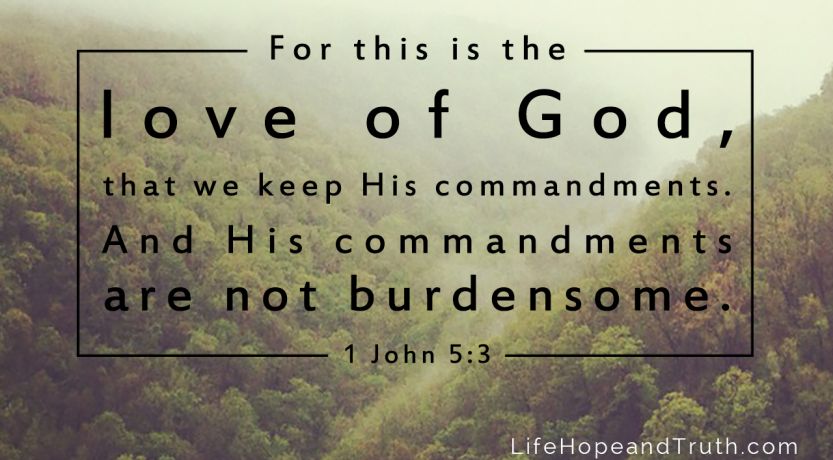
Jesus Christ summed up the Ten Commandments in two broad principles: love of God, “the first and great commandment,” and love of neighbor (Matthew 22:36-39). The Ten Commandments constitute a law of love. “For this is the love of God, that we keep His commandments. And His commandments are not burdensome” (1 John 5:3).

3. God is love

The word love is probably the most misused, misapplied term in the English language. Lustful desire to possess another person most certainly is not real love. Love is so often confused with lust in the TV and movie world. Many are misled into sin by countless fantasy films promoting illicit eroticism. (Stories of how wholesome relationships develop into true romantic love are rare in the entertainment media.)
The New Testament was originally written in Greek, which has the distinct advantage of having different words for different kinds of love. Agape is the term that best describes God Himself. It generally expresses altruistic, outgoing concern for others.
The apostle John explains, “Dear friends, let us continue to love one another, for love comes from God. Anyone who loves is born of God and knows God. But anyone who does not love does not know God— for God is love” (1 John 4:7-8, New Living Translation). Our Creator continually teaches human beings to love both God and neighbor.
Love is the first and foremost expression of God's Holy Spirit (Galatians 5:22). It is the first gift of God that every Christian should seek.
The apostle Paul tells us how love should function in a spiritually transformed person: “Love suffers long and is kind; love does not envy; love does not parade itself, is not puffed up; does not behave rudely, does not seek its own, is not provoked, thinks no evil; does not rejoice in iniquity [sin], but rejoices in the truth; bears all things, believes all things, hopes all things, endures all things. Love never fails” (1 Corinthians 13:4-8).
What is the ultimate, perfect expression of God the Father's love for human beings trapped in their sins? The Bible gives us the answer: “For God so loved the world that He gave His only begotten Son, that whoever believes in Him should not perish but have everlasting life” (John 3:16).

4. God is full of justice and mercy

God's love embraces both justice and mercy. He is a God of justice as well as abundant mercy. It is because of the divine attribute of justice that the penalty for our sins—our transgressions of God's law (see 1 John 3:4)—had to be paid. But it is through divine mercy that Christ died for our sins. Since “the wages of sin is death” (Romans 6:23), the sinless Christ suffered a cruel death in our place so that the God of justice could also show us His great mercy—thereby freely forgiving our sins so He could give us everlasting life.
The Bible takes sin seriously! Sin constitutes rebellion against God, who opposes all forms of evil. Cheap grace has never been part of the Father's plan and is absolutely contrary to His divine character. We have all broken His spiritual law, and true repentance is the first step on our way back to Him.
Yet reconciliation to God the Father could only be made possible by the steepest price imaginable—the shed blood of His Son Jesus Christ. As the apostle Peter expressed it, “You were not redeemed with corruptible things, like silver or gold, from your aimless conduct received by tradition from your fathers, but with the precious blood of Christ, as of a lamb without blemish and without spot” (1 Peter 1:18-19).
When Jesus returns to reign on the earth, He will bring order to the whole world—“and establish it with judgment and justice” (Isaiah 9:7). Also notice that “with righteousness He shall judge the poor, and decide with equity for the meek of the earth” (Isaiah 11:4).
We should never overlook God's justice and His judgments, which are generously tempered by great mercy. James wrote that “mercy triumphs over judgment” (James 2:13). Paul wrote, “Blessed be the God and Father of our Lord Jesus Christ, the Father of mercies and God of all comfort” (2 Corinthians 1:3).

5. God is eternal

Jesus Christ prayed shortly before His agonizing suffering that would end in His death, “And now, O Father, glorify Me together with Yourself, with the glory which I had with You before the world was” (John 17:5). The apostle Paul wrote in his letter to Titus about the “hope of eternal life which God, who cannot lie, promised before time began” (Titus 1:2). God existed before everything!
Remember that “Jesus Christ is the same yesterday, today, and forever” (Hebrews 13:8). The glorified Christ stated, “I am the Alpha and the Omega, the Beginning and the End, . . . who is and who was and who is to come” (Revelation 1:8). “The Alpha and the Omega” is an idiomatic Greek expression denoting “the eternal creative existence of God” ( The New Bible Dictionary, 1974, p. 26).
Hebrews 7:3 speaks of One who has “neither beginning of days nor end of life.” This is the High Priest Melchizedek (verse 1), the One who later became Jesus Christ. (For the biblical evidence, see our free booklet Who Is God? ) Indeed, Christ's existence is “from everlasting” (Micah 5:2).
The prophet Isaiah recorded this awesome truth about God: “For thus says the High and Lofty One who inhabits eternity, whose name is Holy …” (Isaiah 57:15). God the Father and Jesus Christ (the Word) have always existed. They are divine spirit beings (John 4:24). No one created Them. They were present before the beginning of the creation — before time began. They are eternal!

6. God is a family

The apostle Paul exclaimed, “I bow my knees to the Father of our Lord Jesus Christ, from whom the whole family in heaven and earth is named” (Ephesians 3:14-15).
God is not a closed Trinity, but an expanding family. Concerning the Trinity doctrine, The Oxford Companion to the Bible 's opening words under the article “Trinity” are enlightening:
“Because the Trinity is such an important part of later Christian doctrine, it is striking that the term does not appear in the New Testament. Likewise, the developed concept of three coequal partners in the Godhead found in later creedal formulations cannot be clearly detected within the confines of the [New Testament] canon” (Bruce Metzger and Michael Coogan, editors, 1993, p. 782, emphasis added).
The word later here is a vital key in understanding why general Christian belief became burdened with the Trinity doctrine. It wasn't until long after the Bible was written that theologians originally came up with the doctrine, and others added to and elaborated on it down through the centuries.
Regrettably, the Trinity doctrine has been a major barrier to clear comprehension of the biblical truth that God is a divine family. (To understand much more, request or download our free booklet Who Is God? )
The God family is headed by the Father and presently consists of God the Father and God the Son, Jesus Christ. Their plan and desire is fully focused on “bringing many sons [and daughters] to glory” (Hebrews 2:10). This has been planned from the beginning.
Jesus Christ is “the firstborn from the dead” (Colossians 1:18)—“the firstborn among many brethren” (Romans 8:29). These passages mean that many more are going to join the family as divine spirit beings like the Father and Christ at the first resurrection, when the righteous are raised to everlasting life (see 1 Corinthians 15:49-54; 1 John 3:1-2; Revelation 20:6).
Those who are truly converted and have received God's Holy Spirit are already reckoned to be a part of the family (again, see Ephesians 3:14-15). They await the final step at the second coming.
At that time Jesus “will transform our lowly body that it may be conformed to His glorious body” (Philippians 3:21). Then it can be said in its fullest sense, “I will be a Father to you, and you shall be My sons and daughters, says the Lord Almighty” (2 Corinthians 6:18).
Even this supremely important step involves only the firstfruits of God's salvation, as He will eventually add countless others to His family. (For further knowledge of our Creator's awesome plan and purpose for humanity, request or download our free booklet What Is Your Destiny? )

7. God is the great Healer

In spite of all the wondrous achievements and advancements in medical science, mankind is still plagued by diabetes, cancer, heart disease, AIDS, a host of harmful addictions and unending chronic ailments. Certain medicines can aid the healing process, though sometimes with serious side effects. Human beings still desperately need divine healing.
Over time our Creator has made it possible for doctors and researchers to gain marvellous insights into how our bodies function. Jesus Christ never spoke against the physicians of His day. On the contrary He said on one occasion, “Those who are well have no need of a physician, but those who are sick” (Matthew 9:12). Luke, who travelled extensively with the apostle Paul and wrote a large portion of the New Testament, was called “the beloved physician” (Colossians 4:14).
All that properly said, most Christians do not realize that the Bible describes God as our healer. “I am the LORD who heals you,” He says (Exodus 15:26). Yet His miracle-working power does not always find much favor in our largely secular society. Even in a local area of the Holy Land some 2,000 years ago, the Bible states that Jesus “could do no mighty work there, except that He laid His hands on a few sick people and healed them. And He marveled because of their unbelief” (Mark 6:5-6).
Nonetheless, He healed many during His earthly ministry: “Then Jesus went about all the cities and villages, teaching in their synagogues, preaching the gospel of the kingdom, and healing every sickness and every disease among the people” (Matthew 9:35). Still, many today are suspicious of divine healing, with even religious people assuming the day of miracles has passed into history.
A noted British theologian rightly contradicted this common assessment: “To deny even the possibility of miracles, whether from theological prejudice or scientific secularism, borders on the absurd. Since we believe that God is the sovereign Creator of the universe, he is certainly able to intrude into his own world. We have no liberty either to lock him up into one of our neat little boxes or to dictate to him what he is permitted to do” (John Stott, Evangelical Truth, 2003, p. 124).
Many Christians are not even aware of the Bible's instruction when they become ill: “Is anyone among you sick? Let him call for the elders of the church, and let them pray over him, anointing him with oil in the name of the Lord” (James 5:14). What is expected to happen? “And the prayer of faith will save the sick, and the Lord will raise him up” (verse 15). But we should leave the way and the time to God's determination, as verse 16 indicates.
Jesus said, “According to your faith, let it be it unto you” (Matthew 9:29). To understand how to increase your faith, request or download our free booklet You Can Have Living Faith .

8. God is the ultimate planner

All human beings are important in God's eyes. The first man and woman were the crown of His physical creation. After all, He made them in His own image (Genesis 1:26-27), and we are their offspring.
Jesus Christ said, “And I, if I am lifted up from the earth [referring to His crucifixion that would soon take place], will draw all peoples to Myself” (John 12:32). The first step in God's plan for humankind was the sacrifice of His Son so our sins could be forgiven. But His divine plan doesn't stop there.
Notice what Paul told the Christians of Ephesus: “He made known to us his secret purpose, in accordance with the plan which he determined beforehand in Christ, to be put into effect when the time was ripe: namely that the universe, everything in heaven and earth, might be brought into a unity with Christ” (Ephesians 1:9-10, Revised English Bible).
In this present age, much remains in chaos and confusion. “For we know that the whole creation groans and labors with birth pangs together until now” (Romans 8:22). But it won't always be this way. Read the next verse: “Not only that, but we also who have the firstfruits of the Spirit, even we ourselves groan within ourselves, eagerly waiting for the adoption [or full rights of sonship], the redemption of our body [at the time of the resurrection]” (verse 23).
A little earlier Paul had written that “the earnest expectation of the creation eagerly waits for the revealing of the sons of God” (verse 19). God is going to straighten everything out with the help of His resurrected saints. That is why He is calling the firstfruits of His family during this age of man. Many more will be called to salvation in due time.
God will complete His great purpose in the step-by-step order revealed in the Bible. Our Creator has revealed all seven steps of His majestic divine plan through the observance of the annual biblical festivals. To understand each one, ask for or download our free booklet God's Holy Day Plan: The Promise of Hope for All Mankind .

9. God reveals the future

No human seer or prophet could have accurately predicted the remarkable rise and fall of nations, leaders and people foretold in the Bible. God counsels us all to “remember the former things of old [the things He has already accomplished], for I am God, and there is no other; I am God, and there is none like Me, declaring the end from the beginning, and from ancient times things that are not yet done” (Isaiah 46:9-10).
Our Creator “calls those things which do not [yet] exist as though they [already] did” (Romans 4:17). He has the power, foresight and wisdom to bring things to pass according to His great plan and purpose for mankind. “Indeed I have spoken it; I will also bring it to pass. I have purposed it; I will do it” (Isaiah 46:11).
God not only foretells a wondrous future world of prosperity, peace and plenty, but also a time of horrifying catastrophes that man will first bring on himself. Although our expanding modern technology, growing exponentially, lavishes on us many labor-saving devices our forefathers could only dream of, it has also produced incalculable means of self-destruction threatening our security.
Meanwhile crime and violence, sickness and disease, famine and starvation, poverty and unhappiness are accelerating just as God prophesied in His Word long ago. He is a living God of love and mercy, justice and compassion—and He will intervene to save humanity from itself (Matthew 24:21-22).
If God did not exist, truly our fate would be tragically sealed and all human life doomed. But He is our living, intervening God. He is quite aware of present world trends and is deeply concerned about our own self-inflicted plight. Humanity is caught in a destructive trap of rebellion against our Creator—and we are completely helpless to deliver ourselves out of it.
That is why God the Father will send His Son Jesus Christ back to earth to save us from ourselves (Revelation 11:15). Christ, with His glorified followers from this age, will personally and directly rule over humankind for a 1,000-year period of incomprehensible well-being (Revelation 20:4-6). During that millennial period many billions of people will be brought to real repentance through the word of God going to all nations from Jerusalem.
To understand the historic scope and the overall panorama of future events, request or download our free booklet You Can Understand Bible Prophecy  .

10. God cares for you

Diana, Princess of Wales (1961-1997), brought caring and compassion into the forefront of the public mind. Noted British historian and journalist Paul Johnson wrote, “She had the most princely gift of making the most insignificant person feel important to her, the recipient of her undivided attention, no longer excluded and ignored but brought into the warm circle, welcomed, cherished, made much of.”
Caring and compassion is one divine attribute that people sometimes overlook in considering our Creator. But King David didn't. He exclaimed: “But You, O LORD, are a God full of compassion, and gracious, longsuffering and abundant in mercy and truth … You, Lord, have helped me and comforted me” (Psalms 86:15-17).
In the Gospels we read that “when Jesus went out He saw a great multitude; and He was moved with compassion for them, and healed their sick” (Matthew 14:14). The apostle James later wrote that “the Lord is very compassionate and merciful” (James 5:11).
This sinning world in which we live inevitably creates much anxious worry in many people. But the apostle Peter tells us to exhibit true humility and trust in God in “casting all your care upon Him, for He cares for you” (1 Peter 5:6-7). God is the ultimate caregiver!
David beautifully expressed our Creator's care and concern for you: “Bless the LORD, O my soul, and forget not all His benefits: who forgives all your iniquities, who heals all your diseases, who redeems your life from destruction, who crowns you with lovingkindness and tender mercies” (Psalms 103:2-4).

Summing up

One passage in the book of Ephesians sums up what God wants His people to know and understand about Him. Paul told the Christians he wrote to that he prayed for them with this in mind: “that the God of our Lord Jesus Christ, the Father of glory, may give to you the spirit of wisdom and revelation in the knowledge of Him, the eyes of your understanding being enlightened; that you may know what is the hope of His calling, what are the riches of the glory of His inheritance in the saints, and what is the exceeding greatness of His power toward us who believe, according to the working of His mighty power” (Ephesians 1:17-19).
Our prayer likewise is that you will seek understanding of your Creator, receive what He reveals and experience the power of Him working in your life! GN